At a glance
- The Québec City CMA’s labour market continues to rebalance after several months of overheating, while remaining one of the strongest-performing labour markets in Canada.
- Despite a better match between labour supply and demand, conditions remain uneven across sectors, as recruitment challenges and skill mismatches persist, highlighting the diversity of labour market realities.
After several months of overheating, the region’s labour market is entering a new phase of rebalancing. The decline in employment in June in the Québec City CMA—the largest since May 2020—points to a gradual return to more sustainable conditions, while the region maintains one of the highest levels of labour force participation and labour market engagement in Canada. – Carl Viel, President and CEO, Québec International
Highlights – June 2026
Full employment at the start of summer
Summer is here, and the tourism industry is entering one of the busiest periods of the year in the greater Québec City region. The end of the school year and the start of the vacation season are bringing a large number of visitors to the region, boosting employment in the accommodation and food services (+8.8%) as well as information, culture and recreation (+0.5%) sectors, based on non-seasonally adjusted data. This further strengthens Québec City’s already favourable tourism outlook and suggests that tourism performance in 2026 could surpass the solid results recorded in 2025.
This surge in activity is creating greater recruitment needs for many businesses, which could help slow the decline in employment observed in June. However, with the CMA already at the full-employment threshold, this additional demand reflects a market in which the supply of talent continues to be under considerable pressure.
Analysis
A more balanced labour market, but not without challenges
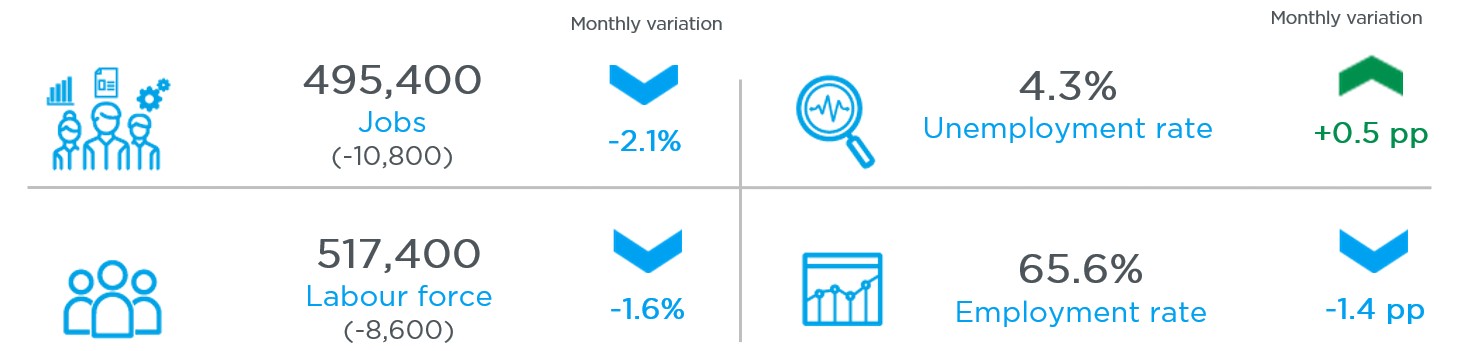
According to Statistics Canada’s Labour Force Survey (LFS), the Québec City CMA’s labour market recorded a significant decline in June 2026. Employment fell by 2.1% to 495,400 workers, while the unemployment rate rose by 0.5 pp, reaching 4.3%. The shift in these indicators reflects a broader labour market rebalancing following more than six months of overheating.
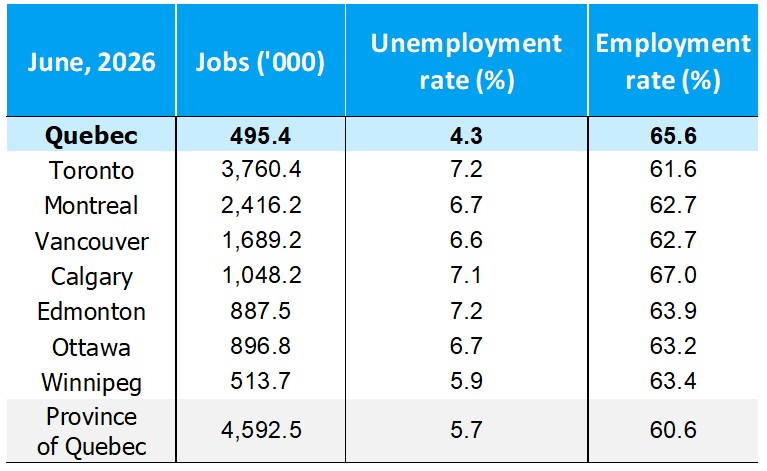
Nevertheless, the increase in the unemployment rate does not undermine the Québec City CMA’s enviable position nationally, as the region retains second place in Canada, behind Saguenay (3.4%). At the same time, Québec City ranks second among Canadian CMAs in terms of its employment rate (65.6%), behind Calgary (67.0%), highlighting a still-high level of labour utilization, well above that of other major comparable CMAs, including Montréal (62.7%).
The labour force also declined in June, reaching 517,400 people (-1.6%), the largest decrease since September 2025. The province of Quebec recorded a slight drop of 0.1%, and the region now appears to be converging toward the provincial trend after diverging from it in recent months. However, the unemployment rate’s return to a level consistent with full employment indicates that labour demand remains strong, yet better aligned with labour supply than in recent months.
June marks a turning point in the region’s labour market rebalancing. Despite the rise in the unemployment rate to a level consistent with full employment, labour shortages persist in several key sectors due to a mismatch between available skills and those in demand. Now more than ever, it is important to recognize the multiple realities of the labour market rather than view it as a uniform whole. – Rosalie Forgues, Senior Economist
Data visualization
Evolution of the key employment indicators over one year
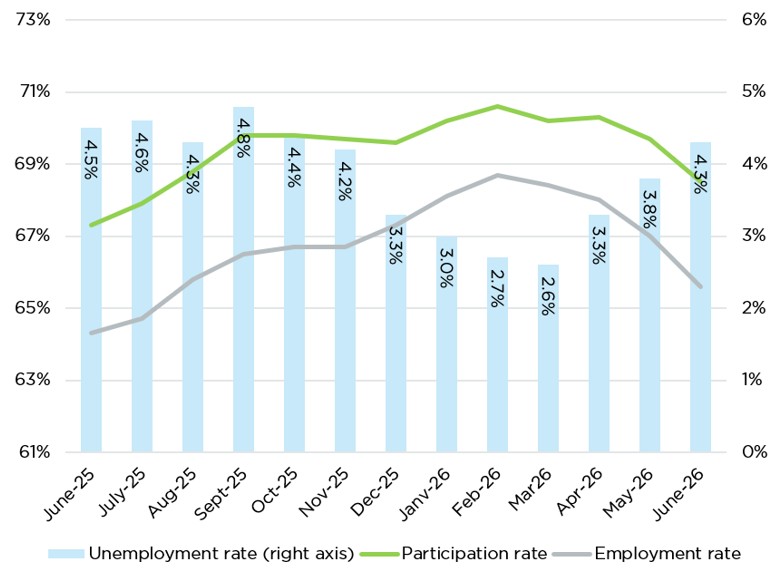 Sources: Statistics Canada, Table 14-10-0459-01, and Québec International.
Overview of employment in major Canadian regions
Rosalie Forgues
Senior Economist
Québec International