Highlights – December 2025
Data visualization
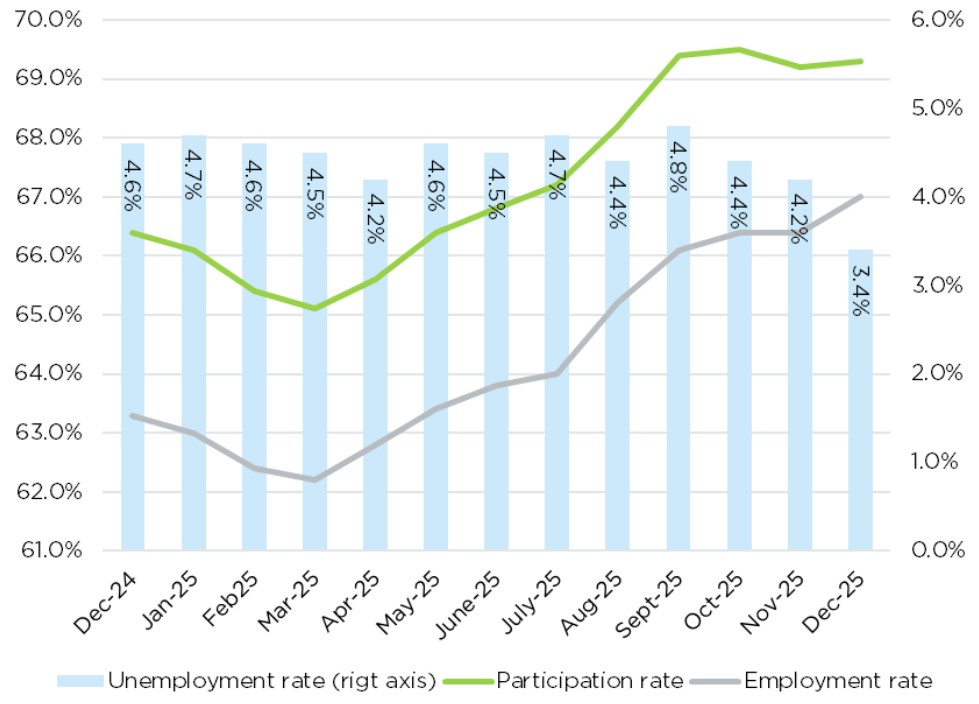
Evolution of the key employment indicators over one year
 Sources: Statistics Canada, Table 14-10-0459-01, and Québec International.
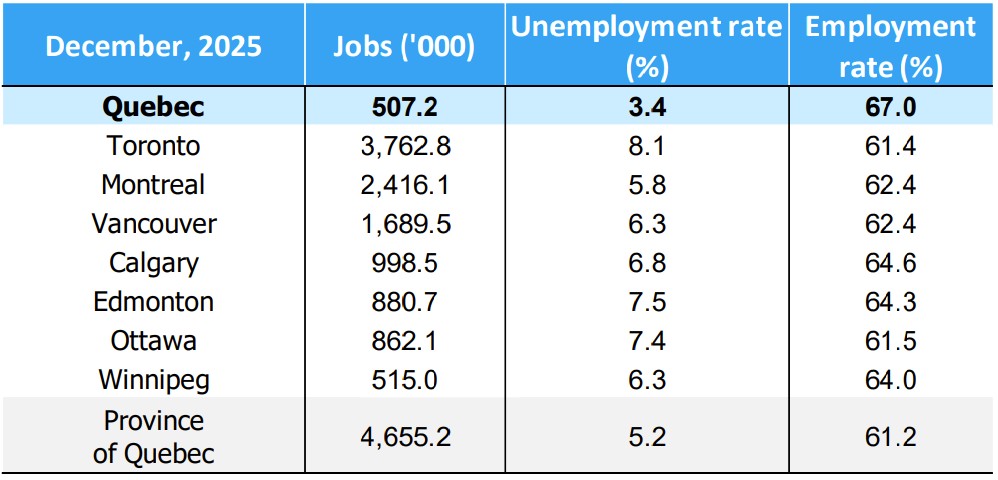
Overview of employment in major Canadian regions
Analysis
Sustained performance in the region in December
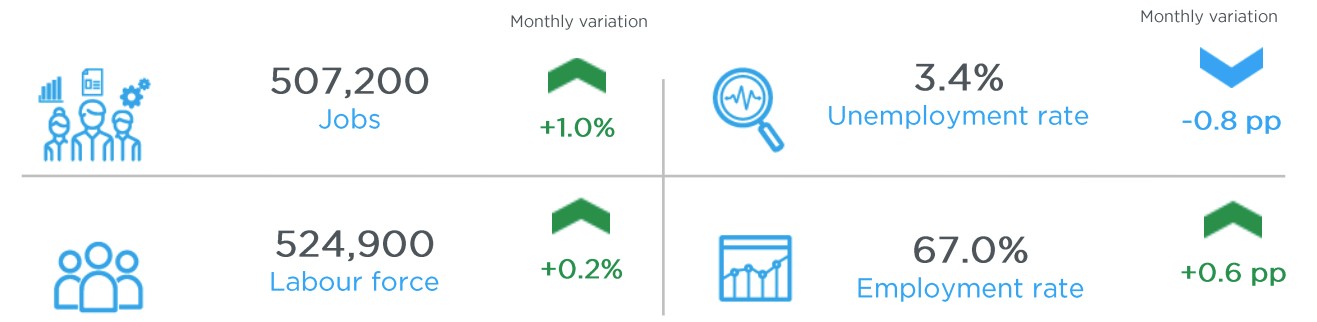
Based on Statistics Canada’s Labour Force Survey (LFS), Québec City had a solid performance in December 2025, with 507,200 jobs (+1.0%) and a growth of 524,900 people in the labour force (+0.2%). The employment rate crossed the 67.0% threshold (+0.6 pp) for the first time in over two years, while the unemployment rate settled at 3.4% (-0.8 pp), the lowest in 17 months, putting the region in first place among Canadian CMAs for this indicator.
Contrasting results in 2025, cautious outlook for 2026
With 2025 characterized by sharp contrasts in the way each sector evolved, LFS results reveal overall good resilience of the labour market amid the uncertain economic context. Employment grew at a steady rate (+7.3%), outpacing previous years, while the labour force grew by 5.9%, crossing the half-million threshold in October.
This dynamic helped maintain the unemployment rate within a relatively stable range, varying between 4.8% in September and 3.4% in December. The employment rate grew by 3.7 pp over the same period. At the end of the year, job creation was more concentrated in key sectors, like construction, while other sectors showed signs of a slowdown, including manufacturing and professional, scientific and technical services.
The trends observed in 2025 are explained in part by the gradual normalization of economic conditions in a highly uncertain context, as well as the impact of structural factors, like the aging of the population and labour force adjustments. While the pressure on the labour force was lessened compared to previous years, skill shortages persist, fuelling concerns over a lack of talent in key sectors of the economy. This situation continues to put pressure on employers and reducing the gap between available and required skills, a concern heightened by immigration constraints.
Labour market forecasts for the coming months point to a cautious evolution of indicators. Growth in employment should continue, albeit at a moderate pace, in a context where businesses remain vigilant about economic and financial conditions, thus maintaining the unemployment rate at a similar level to those observed in 2025. However, labour force evolution will remain dependent on several factors, including the global economic context, public policy and the capacity to adapt to structural changes.
Rosalie Forgues
Économist
Québec International