“Current indicators confirm a persistent mismatch between the skills sought by businesses and the qualifications of available candidates, which represents a structural obstacle to productivity gains and business growth.” – Carl Viel, President and CEO, Québec International
Highlights – Fourth quarter of 2025
Beyond the number of vacant positions, what impact on our economy?
Unemployment-to-job vacancy ratio | Comparative trends in wages and inflation |
Metric contracting: from ≈1.30 to ≈0.94 between Q4 2024 and Q4 2025. | Capitale-Nationale: $28.25/hr (-0.2%); Chaudière-Appalaches: $27.10/hr (+2.3%). |
| • Salaries are growing more slowly than inflation (2.6%), putting additional pressure on sectors where recruitment is already a challenge. • The gap between CPI and wages reflects: (1) employers’ reduced ability to keep up with rising prices, and (2) heightened challenges in attracting and retaining staff. |
Analysis
A tightening labour market and increased labour needs
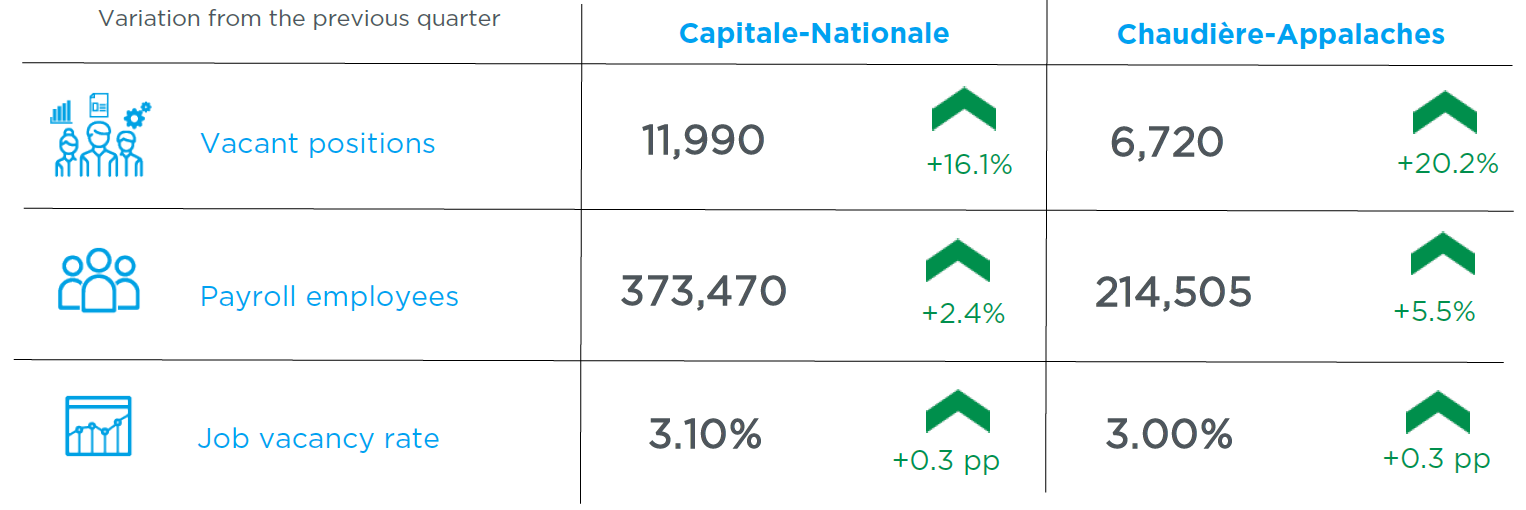
According to Statistics Canada’s Job Vacancy and Wage Survey (JVWS), the Capitale-Nationale and Chaudière-Appalaches regions had a total of 18,710 vacant positions in the fourth quarter of 2025, a 17.5% increase compared to the previous quarter (15,920). Although this adjustment does not constitute a historic break, it does not continue the stability observed over the past five quarters.
Regional trends are similar on either shore, with vacant positions up 16.1% in Capitale-Nationale and 20.2% in Chaudière-Appalaches in the last quarter. However, a divergence emerges on a year-over-year basis, with Capitale-Nationale seeing a small decline of 220 vacant positions, while Chaudière-Appalaches recorded an increase of 1,460.
Persistent mismatch between available jobs and workers
From the third to the fourth quarter of 2025, overall labour demand (payroll jobs and vacant positions, with the exception of self-employed workers) increased by 2.8% in the Capitale-Nationale region and by 5.8% in Chaudière-Appalaches. Conversely, in the province of Quebec and Canada, this metric is almost stagnant, with variations of only 0.0% to 0.6%.
Taken together, the decrease in the unemployment-to-job vacancy ratio and modest wage growth indicate a gradual tightening of the labour market, consistent with the findings of the Labour Force Survey (LFS). This dynamic increases tensions arising from the mismatch between the available skills and those sought by employers, continuing to limit some businesses’ ability to meet operational needs.
“The coming months will confirm whether wages are keeping pace with inflation, as wage growth consistently below inflation would limit employers’ flexibility and intensify recruitment and retention challenges in sectors under pressure.” – Rosalie Forgues, Economist
Data visualization
Graph 1. Evolution of cumulative job vacancies in the combined regions of Capitale-Nationale and Chaudière-Appalaches
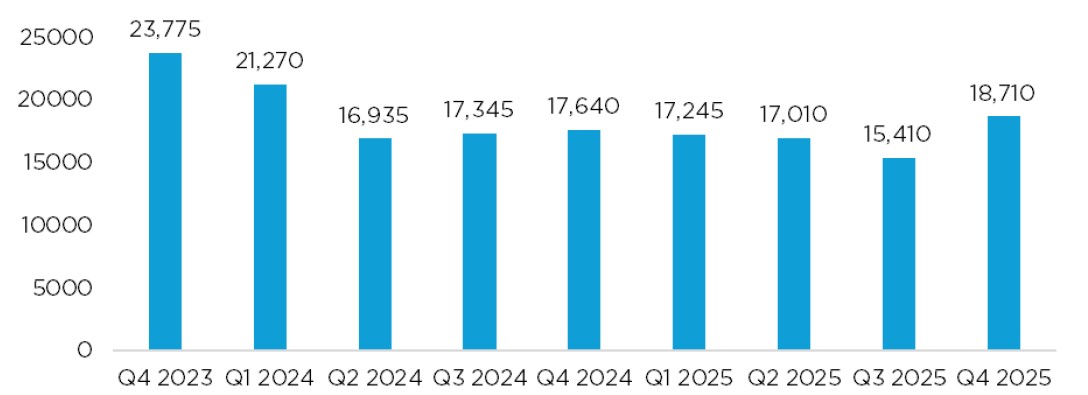 Sources: Statistics Canada, Table 14-10-0398-01, and Québec International.
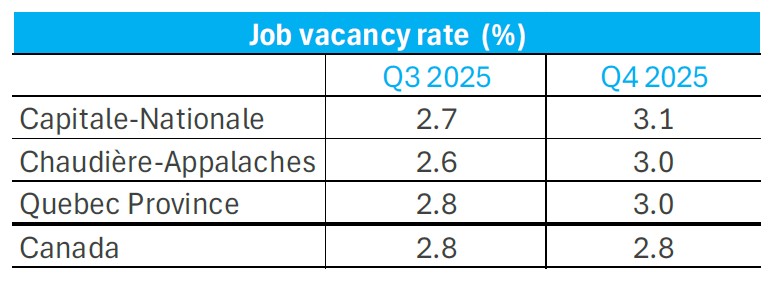
Table 1. Job vacancy rate by region
What is considered a vacant position?
According to the JVWS, a job is considered vacant if it meets the three conditions below:
- It is vacant on the first day of the month, or will become vacant during the month.
- There are tasks to be carried out during the month for the job in question, so it is not a frozen or suspended position.
- The employer is actively recruiting outside the organization to fill the job.
Rosalie Forgues
Economist
Québec International