Highlights – Third quarter of 2025

Data visualization
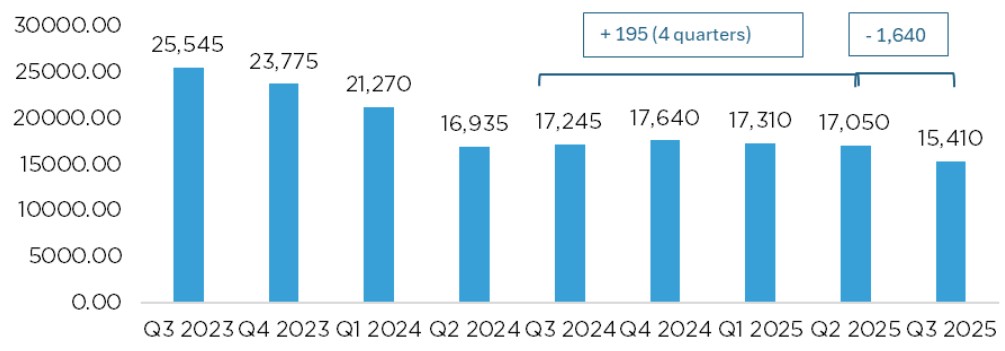
Graph 1. Evolution of cumulative job vacancies in the combined regions of Capitale-Nationale and Chaudière-Appalaches
 Sources: Statistics Canada, Table 14-10-0398-01, and Québec International.
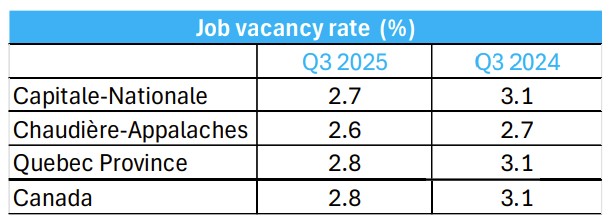
Table 1. Job vacancy rate by region
Analysis
Lower number of vacancies in the Capitale-Nationale and Chaudière-Appalaches regions
According to Statistics Canada’s Job Vacancy and Wage Survey (JVWS), the third quarter of 2025, when the Bank of Canada changed its key interest rate to 2.25%, saw a significant drop in the number of vacant positions in the Capitale-Nationale and Chaudière-Appalaches regions, breaking with the stability observed in previous quarters. The number of vacancies reached a total of 15,410 in both regions combined, a 9.6% drop compared to the previous quarter (17,050).
However, the evolution was different for each region, as the Capitale-Nationale registered a quarterly decline of 10.6%, compared to 7.8% in Chaudière-Appalaches (2.8 percentage points [pp] lower). Over one year, the Capitale-Nationale region registered a total decrease of 13.9%, compared to only 4.0% in Chaudière-Appalaches. For reference, the province of Quebec and Canada also registered similar drops of -10.2%.
The significant drop in vacant positions in the third quarter of 2025 is explained in part by various sectoral factors, in particular, sensitivity to the economic situation in the manufacturing, construction and public sectors. Other factors include the gradual normalization of the labour market and the delayed effects of the tightening of monetary policy, despite the recent drop in key interest rate. As such, this movement may reflect a reaction to the economic conditions rather than a systemic decline.
Moreover, the increased utilization of overtime, automation and productivity gains allows businesses to maintain their level of activity without creating as many jobs as before, which also contributes to the decrease in vacant positions. This dynamic may influence hiring strategies in 2026, in a context where rates remain stable to support growth without rekindling inflationary pressures, and where the economic situation impacts each industrial sector differently.
Slight decrease in the labour force and contrast in wages
The overall labour demand, which includes vacant positions and payroll employees but excludes those who are self-employed, continues to reflect the contrasted dynamics between the Capitale-Nationale and Chaudière-Appalaches regions. From the second to the third quarter of 2025, labour demand dropped by 3.6% in the Capitale-Nationale region and by 1.5% in Chaudière-Appalaches. On an annual basis, this brings the trend into the negative for the Capitale-Nationale region (-1.5%), but remains stable in Chaudière-Appalaches, with a combined total of 580,755 positions (filled or vacant) (-1.0%) This situation shows how resilient the region’s labour market is despite persisting tensions.
Meanwhile, compensation also follows a different trajectory in each region. While the average hourly wage offered continues to grow in the Capitale-Nationale region, reaching $28.30 (+3.1%) in Q3 2025, Chaudière-Appalaches showed the opposite trend, settling at $26.50 (-4.3%), based on non-seasonally adjusted data.
With 2026 approaching, major investment projects in infrastructure and innovation, announced or underway, should help boost the region’s attractiveness while maintaining pressure on skilled labour availability.
Rosalie Forgues
Économist
Québec International